Home Products Case News About Us Contact Us
Rotary Kiln

Rotary Kiln

Output Size:   Capacity: 200–2500 tons per day (t/d)

Introduction

The cement rotary kiln is a core piece of equipment widely used for the production and calcination of cement clinker. At present, the cement rotary kilns manufactured by our company are mainly designed for dry-process cement clinker production lines. According to different clinker production processes, the product series includes hollow dry-process kilns, kilns with preheaters, and precalciner kilns.

There are a total of sixteen models available, with cylinder diameters ranging from 2.5 m to 4.3 m, capable of meeting dry-process clinker calcination capacities from 180 to 3,200 tons per day.
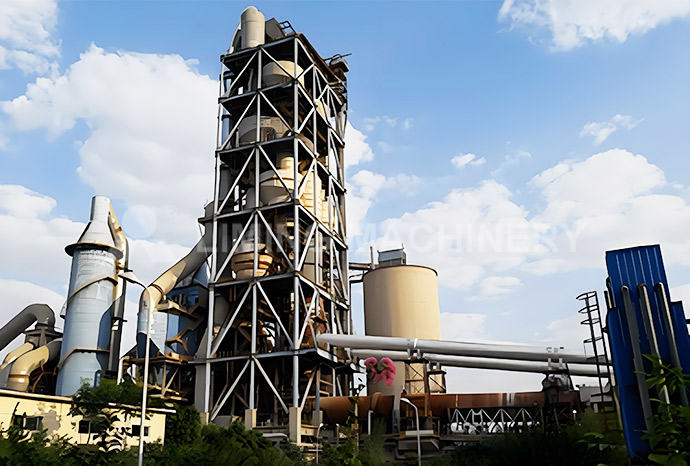

Applications

Suitable for cement plants and various cement clinker production lines.

Features

1. Stable Product Quality
During the calcination process, the kiln ensures uniform heating of materials, resulting in stable and consistent clinker quality.

2. Advanced Transmission System
The main drive system adopts advanced AC variable frequency speed control technology, which features energy efficiency, environmental friendliness, a wide speed regulation range, high transmission efficiency, precise speed control, and stable operation.

3. Reliable Supporting Roller Device
The bases of both the supporting roller device and the thrust roller device are fully welded and treated with vibration stress relief to eliminate welding stress. This significantly improves installation accuracy, operational reliability, and overall service life of the equipment.

4. Optimized Structural Design
The kiln head and kiln tail have been comprehensively optimized to effectively solve common issues such as material backflow at the kiln outlet and dust leakage. This ensures smoother material movement and more stable operation.

Working Principle

Raw material is fed into the kiln from the kiln tail (the higher end). Due to the inclination and slow rotation of the kiln body, the material gradually moves toward the kiln head while undergoing axial and radial rolling. Fuel is injected through the burner at the kiln head (lower end) and combusted to generate heat.

Heat is transferred to the material through radiation, convection, and conduction. As the material moves through the kiln, a liquid phase is formed, producing key clinker minerals such as tricalcium silicate, dicalcium silicate, tricalcium aluminate, and tetracalcium aluminoferrite. After completing the sintering process, the clinker is discharged from the kiln head.

Specifications